About OEDB
The Open Electrolyte Database for Batteries (OEDB) is a comprehensive repository of electrolyte data for battery research and development. Our database contains detailed information about various electrolyte compositions, their properties, and performance characteristics.
This database serves as a valuable resource for researchers, engineers, and students working in the field of battery technology and electrochemistry.
News
- Released a new Experimental Database and updated data (v2026-05-11)
- Released a new Experimental Database including the Raman spectra of 1,560 electrolytes.
- Added RDFs of cation–solvent and cation–anion.
- Added Anion’s and Solvent’s diffusion coefficients.
- The OEDB paper has been accepted for publication in npj Computational Materials. An unedited version of the OEDB paper is now available online at npj Computational Materials (Link).
License
OEDB is released under the CC BY 4.0 (Creative Commons Attribution 4.0 International) license — you are free to share and adapt the data for any purpose, including commercial use, as long as appropriate credit is given.
For research use, please cite our paper.
Citation
The OEDB database and its generation framework are described in the paper:
RIS format
In this research work, we used Open Electrolyte Database for Batteries (OEDB) [#].TY - JOUR
AU - Nakamura, Kou
AU - Takenaka, Norio
AU - Hanai, Masatoshi
AU - Oikawa, Yuna
AU - Tamura, Ryo
AU - Tsuda, Koji
AU - Nakayama, Masanobu
AU - Shiomi, Junichiro
AU - Yamada, Atsuo
PY - 2026
DA - 2026/04/20
TI - Open electrolyte database generated via an automated molecular dynamics simulation framework
JO - npj Computational Materials
AB - Modern battery technologies demand electrolytes that simultaneously deliver multiple functions tailored to diverse applications. Achieving such multi-objective optimization remains fundamentally challenging, as many key electrolyte properties are intrinsically in competition. Data-driven approaches provide a systematic route to navigating the vast compositional space of electrolyte systems; however, their effectiveness critically depends on the availability of comprehensive datasets that capture not only descriptors derived from isolated molecular structures and properties but also structural and physicochemical characteristics of electrolytes as integrated solutions. Here, we report an open electrolyte database comprising approximately 5600 electrolyte formulations, generated using a fully automated, high-throughput molecular dynamics simulation framework. The dataset spans diverse combinations of solvents, salts, and concentrations, and provides unified descriptions of electrolyte structures and physicochemical properties. To facilitate data exploration and utilization, we implement a web-based graphical user interface (https://oedb.jp) that enables interactive browsing and comparison of electrolyte compositions together with their associated descriptors, while also making the database accessible to LLM-based agents for data reference. This Open Electrolyte Database for Batteries (OEDB) establishes a foundation for data-driven electrolyte design grounded in structure–property relationships at the electrolyte level.
SN - 2057-3960
UR - https://doi.org/10.1038/s41524-026-02093-y
DO - 10.1038/s41524-026-02093-y
ID - Nakamura2026
ER - BibTeX format
In this research work, we used Open Electrolyte Database for Batteries (OEDB)~\cite{Nakamura2026}.@article{Nakamura2026,
author = {Nakamura, Kou and Takenaka, Norio and Hanai, Masatoshi and Oikawa, Yuna and Tamura, Ryo and Tsuda, Koji and Nakayama, Masanobu and Shiomi, Junichiro and Yamada, Atsuo},
title = {Open electrolyte database generated via an automated molecular dynamics simulation framework},
journal = {npj Computational Materials},
year = {2026},
month = apr,
day = {20},
issn = {2057-3960},
doi = {10.1038/s41524-026-02093-y},
url = {https://doi.org/10.1038/s41524-026-02093-y}
}Model Context Protocol (MCP)
The OEDB dataset is delivered through the Model Context Protocol (MCP), for the integration with AI agent services (e.g., Claude, ChatGPT etc.). By connecting our MCP server to each AI agent service, researchers can query curated electrolyte records, trigger automated data-processing workflows, retrieve structured exports and so forth.
https://oedb.jp/mcpHow to Connect with Claude CodeClick to expand
Connecting to the OEDB MCP Server from Claude Code
Note: Requires Claude Code installed locally.
- 1
Register the OEDB MCP Server
Run the following command in your terminal to add the OEDB MCP server to Claude Code:
claude mcp add --transport http oedb https://oedb.jp/mcp - 2
Verify the Connection
Start a Claude Code session and run
/mcpto confirm that oedb appears in the list of connected servers. You can now query OEDB directly from your Claude Code sessions.
How to Connect with Claude.aiClick to expand
Connecting to the OEDB MCP Server
Note: Remote MCP connectors are available only to Claude Pro (or higher-tier) accounts.
- 1
Navigate to Connector Settings
Open Claude in your browser and open your profile menu. Choose Settings > Connectors to view the connector list.
- 2
Add the OEDB MCP Server
Scroll to the bottom of the connector list, then click Add custom connector.
In the dialog, enter your preferred Name (e.g, "Open Electrolyte Database for Batteries") and
the following URL in the Remote MCP server URL field:https://oedb.jp/mcp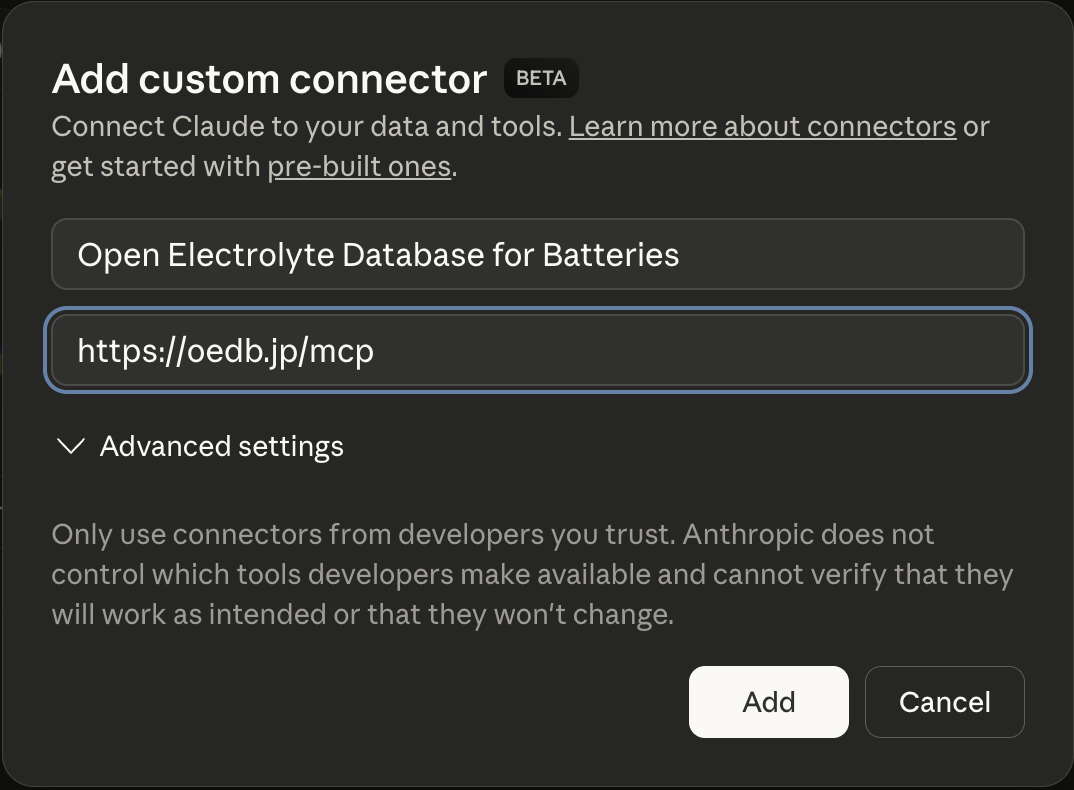
Confirm to Add to register the OEDB MCP connector.
- 3
Complete Authentication
Click Connect from the connector list. Then, the OEDB MCP server is ready to use from your chat sessions.
How to Connect with ChatGPTClick to expand
Our Team
Atsuo YAMADA
Director
Professor, Department of Chemical System Engineering, The University of Tokyo
Junichiro SHIOMI
Associate Director
Professor, Department of Mechanical Engineering, The University of Tokyo
Norio TAKENAKA
Technical Lead
Project Lecturer, Department of Chemical System Engineering, The University of Tokyo
Masatoshi HANAI
Project Assistant Professor, Information Technology Center, The University of Tokyo
Shoichi MATSUDA
Team Leader, National Institute for Materials Science
Kou NAKAMURA
PhD Student, Department of Mechanical Engineering, The University of Tokyo
Supports

MEXT Digital Transformation Initiative for Green Energy Materials (DX-GEM/DxMT)

MEXT Advanced Research Infrastructure for Materials and Nanotechnology in Japan (ARIM)
mdx: Cloud Platform for Supporting Data Science and Cross-Disciplinary Research Collaboration

MEXT Developing a Research Data Ecosystem for the Promotion of Data-Driven Science